You are now leaving Meeder Investment Management. Links to other websites are provided for your convenience and information only. When you click on a link to another website you will be leaving this website. The fact that Meeder Investment Management provides links to other websites does not mean that we endorse, authorize or sponsor the linked website, or that we are affiliated with that website’s owners or sponsors. This material is being provided for informational purposes only and is not a solicitation or an offer to buy any security or to participate in any planning or investment strategy. Unless otherwise indicated, the linked sites are not under our control and we are not responsible for and assume no liability for the content or presentation of any linked site or any link contained in a linked site, or any changes or updates to such sites. We make no representations about the accuracy or completeness of the information contained in any linked sites and their privacy and security policies may differ from ours. We recommend that you review this third-party’s policies and terms carefully.
Staying Disciplined Through Geopolitical Turbulence

The U.S./Israel-Iran Conflict Escalates
The Initial Economic Impact
Caution Ahead of the Headlines
Signal vs. Noise
Portfolio Impact
The U.S./Israel-Iran Conflict Escalates
A direct military conflict has erupted involving the United States, Israel, and Iran, including strikes that hit Iranian military facilities and killed Iran’s Supreme Leader and other top officials. This is a significant escalation of a long-standing geopolitical confrontation—historically managed through a mix of sanctions, proxy clashes, and diplomacy. In response, Iran has launched missile and drone attacks not only at Israel, but across the Gulf toward Arab states including UAE, Saudi Arabia, Qatar, Kuwait, Bahrain, and Jordan.
THE INITIAL ECONOMIC IMPACT
Global stock markets initially sold off before stabilizing Monday, while Tuesday brought more selling of risky assets. The yield on the U.S. 10-Year Treasury also climbed back above 4.0% on renewed inflation fears. The Strait of Hormuz, which borders southern Iran, is one of the most critical energy transportation channels in the world. Roughly 20 million barrels per day of oil—about 20% of the world’s total petroleum liquids consumption passes through the waterway. Although the large majority of crude exports transiting the Strait of Hormuz are bound for Asia, supply disruptions and closure risk have pushed oil and natural gas prices higher—an outcome consistent with prior Middle East conflicts.
EXHIBIT 1
MIDDLE EAST CONFLICTS HAVE THE MOST DIRECT IMPACT ON GLOBAL ENERGY PRICES
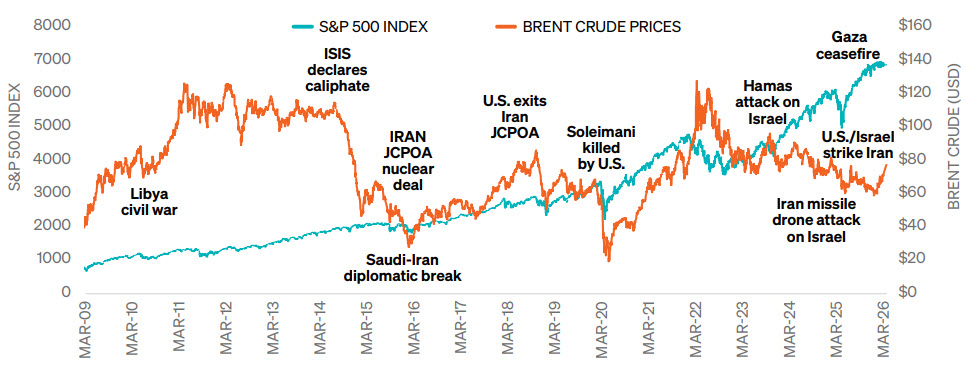
SOURCE: BLOOMBERG, CLEARNOMICS, AS OF 3/2/26
CAUTION AHEAD OF THE HEADLINES
Market positioning heading into the conflict suggests investors were already cautious, which likely contributed to the relatively muted reaction to the conflict initially. While the situation could still escalate or persist longer than markets currently expect, several indicators pointed to elevated bearish sentiment even before the recent escalation.
» Investors purchased downside protection: The 10-day average put/call ratio rose to its highest level since April 2025, signaling increased demand for hedges. At the same time, the put/call skew for 3-month S&P 500 options ranks in the 99th percentile of the past three years, indicating elevated concern about potential downside risks.
» Retail investors turned bearish: The AAII Sentiment Survey, which tracks weekly bullish, bearish, and neutral views among individual investors, recently showed more bears than bulls—even with major equity indexes trading near all-time highs.
» Large U.S. Treasury flows: Treasury yields moved sharply lower in February as investors rotated into safe-haven bonds amid heightened risk aversion. The flight to safety lifted Treasury prices and pushed yields down across the curve, with the most pronounced moves in longer maturities.
SIGNAL VS NOISE
History suggests that economic fundamentals tend to have a larger impact on long-term stock market returns than geopolitical shocks. While short-term volatility is common, the data shows that markets have historically recovered and moved higher in a majority of the cases within 6 to 12 months.
One reason markets often stabilize after geopolitical shocks is that uncertainty, while uncomfortable, eventually becomes quantifiable. Once investors can assess the scope and likely economic impact of an event, risk can be priced in more efficiently, reducing the premium associated with the unknown.
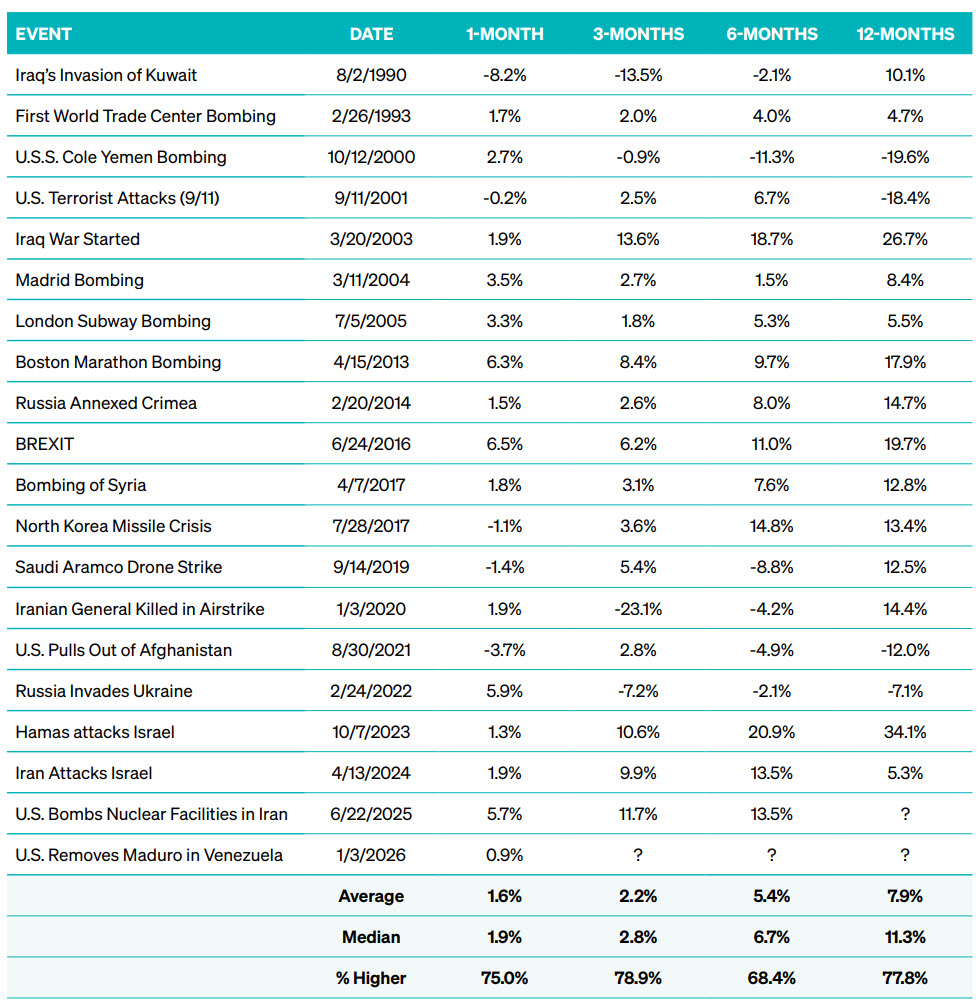
SOURCE: BLOOMBERG, AS OF JANUARY 2026
PORTFOLIO IMPACT
At Meeder Investment Management, our approach is designed specifically for environments like this—where uncertainty is elevated, but long-term opportunity remains.
Across our tactical mutual funds and model portfolios, including defensive equity strategies, we actively assess risk conditions and adjust exposures based on our systematic, multi-factor process. Our separately managed accounts offer flexible implementation and direct security ownership, allowing us to tailor portfolios to each client’s unique objectives while actively managing tax efficiency. Through Edge Investment Consulting, we help advisor practices navigate periods of volatility with disciplined portfolio construction and active oversight.
While geopolitical events can drive short-term volatility, our focus remains on managing risk prudently, staying grounded in capital market fundamentals, and positioning portfolios to participate in long-term growth within each client’s risk profile.
The views expressed herein are exclusively those of Meeder Investment Management, Inc., are not offered as investment advice, and should not be construed as a recommendation regarding the suitability of any investment product or strategy for an individual’s particular needs. Investment in securities entails risk, including loss of principal. Asset allocation and diversification do not assure a profit or protect against loss. There can be no assurance that any investment strategy will achieve its objectives, generate positive returns, or avoid losses.
Commentary offered for informational and educational purposes only. Opinions and forecasts regarding markets, securities, products, portfolios, or holdings are given as of the date provided and are subject to change at any time. No offer to sell, solicit, or recommend any security or investment product is intended. Certain information and data has been supplied by unaffiliated third parties as indicated. Although
Meeder believes the information is reliable, it cannot warrant the accuracy, timeliness or suitability of the information or materials offered by third parties.
Investment advisory services provided by Meeder Advisory Services, Inc. Investment products distributed by Meeder Distribution Services, Inc., Member FINRA | SIPC | MSRB.
©2026 Meeder Investment Management, Inc.
0379-MAS-3/3/26-53614